Please note that the English version of this text has been prepared with the assistance of AI, and in some instances, it may not have been subsequently reviewed or edited by the authors.
Researchers at the Department of Pharmaceutical Sciences, Faculty of Medicine and Life Sciences of the University of Latvia (UL), are developing a new laboratory platform that in the future could help determine which drugs might be most effective for a particular pancreatic cancer patient. The platform is based on a “tumor-on-a-chip,” a microfluidic model that makes it possible to mimic the interaction between a tumor and blood vessels in the laboratory and test the effects of drugs.
Pancreatic cancer is one of the most aggressive malignant tumors. It is often detected late, treatment options are limited, and mortality remains very high. According to statistics available from the Centre for Disease Prevention and Control, 364 new cases of pancreatic cancer were registered in Latvia in 2024, while 420 people died from this disease within the year.¹ This means that the disease burden on public health is heavy: many patients receive a diagnosis at a time when the tumor has already spread to other organs and treatment has become much more complicated.
The most common form of pancreatic cancer is pancreatic ductal adenocarcinoma. In its early stages, it usually does not cause specific symptoms, so the disease is often mistaken for other health problems or noticed late. Data from Latvia confirm this trend: in 2024, stage IV pancreatic tumors were diagnosed in 170 patients, while in stage I it was diagnosed in only 33 patients. It most commonly affects people aged 65 to 69. The risk increases with age, but lifestyle and other health problems also play a major role.¹
Treatment helps, but not everyone equally
Treatment for pancreatic cancer may include surgery, radiation therapy, chemotherapy, or a combination of these methods. If the tumor is detected early and is resectable, surgical treatment combined with adjuvant therapy offers the best chances. However, at the time of diagnosis, surgery is possible for only a fraction of patients.
Although the chemotherapy drugs and their combinations available today can prolong patient survival, they are not always equally effective for everyone. Furthermore, the treatment can cause severe side effects, forcing some patients to discontinue therapy.
Therefore, one of the challenges of personalized medicine is to better understand in advance how a specific patient's tumor might react to different drugs. To study this, a research team from the University of Latvia, in cooperation with doctors from the Riga East Clinical University Hospital, is implementing the PREDICT-PDAC project, which has received funding from the Biomedicine and Photonics Innovation Platform “BioPhoT”. The aim of the project is to develop a laboratory platform for testing the efficacy and toxicity of pancreatic cancer drugs.
Researchers are creating a so-called “tumor-on-a-chip,” a microfluidic device that makes it possible to mimic the interaction between a tumor and blood vessels, drug flow, and the tissue environment in a laboratory much closer to how it happens in the human body. In the future, such an approach could help doctors choose the most appropriate therapy for a patient, avoid unnecessarily harsh treatment, and at the same time serve as a new tool in the development of anti-cancer drugs.
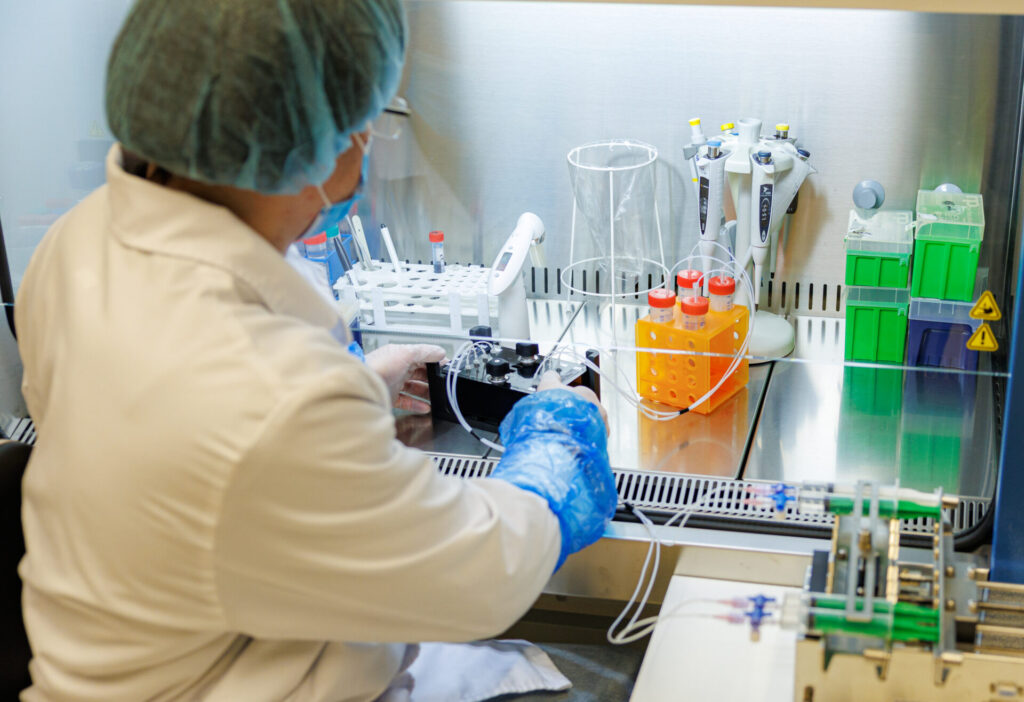
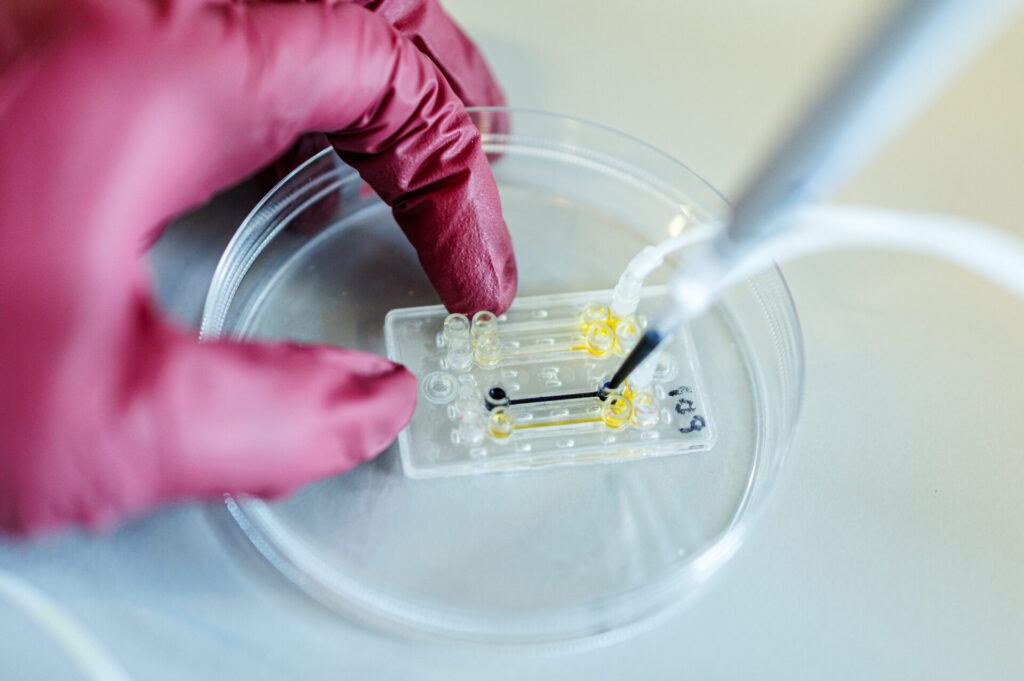
Microfluidic chip and its maintenance. Photo: Dmitrijs Suļžics.
What is a “tumor-on-a-chip”?
Unlike traditional cell culture models, the microfluidic chip allows for the modeling of fluid flow, tissue physical properties, nutrient and drug delivery, as well as tumor interaction with blood vessels.
This is particularly important in the case of pancreatic cancer, because the tumor cells are surrounded by a prominent, dense layer of connective tissue and other microenvironmental cells, which can limit the access of drugs to the tumor and affect its response to therapy.
Visually, the chip is made of two interconnected channels separated by a porous membrane. It ensures the permeability of nutrients and drugs while allowing to simulate the interaction between a tumor and a blood vessel in the organism. Blood vessel cells are cultured in one channel, while the tumor microenvironment is replicated in the other. When a chemotherapy drug is introduced into the blood vessel channel, it can also reach the tumor cells through the blood-vessel barrier. Thus, it is possible to evaluate not only how the tumor responds to the therapy, but also what happens to the blood vessel cells, for example, how severely the cells are damaged by the effect of chemotherapy.
Why is an individual treatment approach necessary, or why doesn't one treatment plan fit everyone?
Pancreatic cancer is complex not only because of the tumor cells themselves. The characteristics of the tumor microenvironment, a dense connective tissue layer, vascular structure, reduced blood supply, and the complex interaction with surrounding cells also play a major role, which significantly affects the action of drugs.
Therefore, genetic information alone is not always able to precisely predict how a tumor will react to specific drugs. This is precisely where functional precision medicine becomes significant, an approach where the choice of therapy in the future could be based not only on the tumor's molecular profile, but also on its actual response to drugs in a laboratory-created model.
A step towards more precise cancer treatment
The long-term goal of PREDICT-PDAC is much broader: to create a clinically applicable platform that could help physicians make therapeutic decisions. In the future, such a system could be used to test multiple treatment options available to the patient and select the one that yields the best effect with the lowest risk of toxicity in a given case.
Such an approach would be particularly significant in situations where there is no clear-cut standard therapy choice. For example, for patients who are not strong enough for intensive chemotherapy, it would be possible to compare less toxic drug combinations. Meanwhile, for patients with a resectable tumor, the functional test could help select the most appropriate therapy before or after surgery. Currently, the work is still in an early research stage: the platform itself is being built and characterized to test how reliably it can reflect the tumor's response to drugs.
The PREDICT-PDAC solution could play a role not only in personalized treatment, but also in the development of new anticancer drugs. A major challenge in the pharmaceutical industry is that many drug candidates look promising in laboratory studies, but later fail to show the expected effect in clinical trials or cause unacceptable toxicity.
Physiologically more accurate “organs-on-chips” models allow evaluating drug effects under conditions that are closer to the human body than traditional cell cultures. This could help select the most promising drug candidates earlier and reduce the risk of failure in late-stage drug development.
Although organ-on-a-chip technology has not yet become an everyday clinical standard, its potential is increasingly being recognized by regulatory institutions as well. In September 2024, the Center for Drug Evaluation and Research of the US Food and Drug Administration accepted for evaluation, for the first time, an organ-on-a-chip technology application for the ISTAND pilot program. This system is designed to predict the potential toxic effects of drug candidates on the liver.²
The study is being developed within the framework of the Biomedicine and Photonics Innovation Platform “BioPhoT” project “PREDICT-PDAC: Real-time drug efficacy and integrated cytotoxicity testing platform in pancreatic ductal adenocarcinoma”, No. OSI_PIP_BioPhoT-2025/2-0095.
References
1. Health statistics database of the Centre for Disease Prevention and Control. Retrieved from: https://statistika.spkc.gov.lv/pxweb/lv/Health/Health__Saslimstiba_Slimibu_Izplatiba__Onkologija/?tablelist=true
2. FDA’s ISTAND Pilot Program accepts a submission of first organ-on-a-chip technology designed to predict human drug-induced liver injury (DILI). Retrieved from: https://www.fda.gov/drugs/drug-alerts-and-statements/fdas-istand-pilot-program-accepts-submission-first-organ-chip-technology-designed-predict-human-drug