Please note that the English version of this text has been prepared with the assistance of AI, and in some instances, it may not have been subsequently reviewed or edited by the authors.
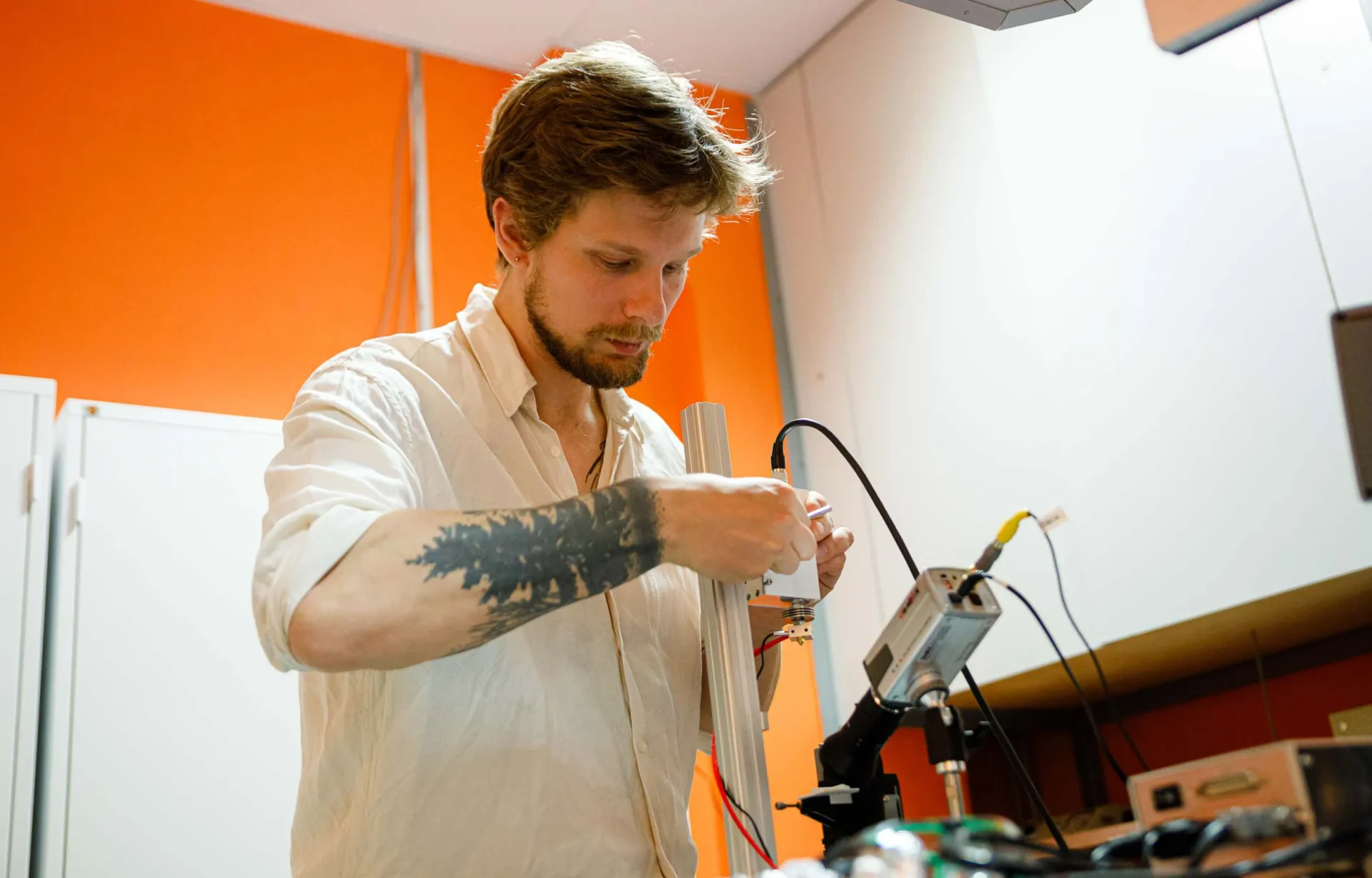
Traditional electronic microchips are rapidly approaching their physical limits, but researchers at the Institute of Solid State Physics of the University of Latvia (LU CFI) are already working on a solution. The LTV feature highlights the scientists' work on next-generation photonic microchips – an innovation rapidly gaining widespread recognition due to its potential to improve data processing and transmission in both current and future technologies.
In the news story Leading researcher at the Institute of Chemical Physics of the University of Latvia and the BioPhoT platform “Phipic” project manager Arturs Bundulis explain how a team of researchers replaces standard electrical signals with light, enabling data transmission at unprecedented speeds.
By integrating microscopic optical fibers directly onto the chip surface, researchers can use different colors of light as parallel data streams. “Instead of having a single electrical signal carrying information, you have a whole rainbow that can carry information in parallel,” notes Bundulis.
Leaving aside data processing speed and the potential for significantly faster internet and streaming services, this technology has two significant advantages over traditional electronics:
- Unlike the ones and zeros of electrical signals, which are easy to read, the laws of physics make it impossible to copy information encoded in the polarization of a photon, thereby ensuring next-level cybersecurity.
- Light transmission does not emit as much heat as is generated using electricity, significantly reducing the need for energy-intensive cooling systems, such as in data centers.
The first prototypes of this new generation of chips have already been created and are currently being tested. “In principle, we are pioneers in Europe and, one might say, also in the world, trying to build such chips,” emphasized Bundulis. As this innovative and economically advantageous technology becomes increasingly relevant, the “Phipic” project continues its work to make the future of “light computers” a reality right here in Latvia.