Please note that the English version of this text has been prepared with the assistance of AI, and in some instances, it may not have been subsequently reviewed or edited by the authors.
Whether it is a wristwatch hand, emergency exit signs, or the greenish-glowing stars on a nursery ceiling, persistent-luminescence or phosphorescent materials have been useful in our daily lives for more than 20 years. We often perceive them as cute trinkets and decorative elements, but in materials science and photonics, the ability to store light energy and later slowly emit it into the environment holds great potential, for example, in engineering and the safety sector.
At the Institute of Solid State Physics, University of Latvia (ISSP UL), research in luminescence, materials physics, and photonics has a decades-long history, which has created a rich base of fundamental knowledge. This has allowed the institute's researchers to participate in the “BioPhoT” program, a photonics and biomedical innovation initiative that helps Latvian scientists“ ideas transform into commercially successful products. How? Research teams can apply to ”BioPhoT" calls with a science-based idea, the main goal of which is to develop a service or product accessible to society and industry. The ideas are evaluated by a panel of science and business experts, and the most promising ideas can begin development with the platform's support.
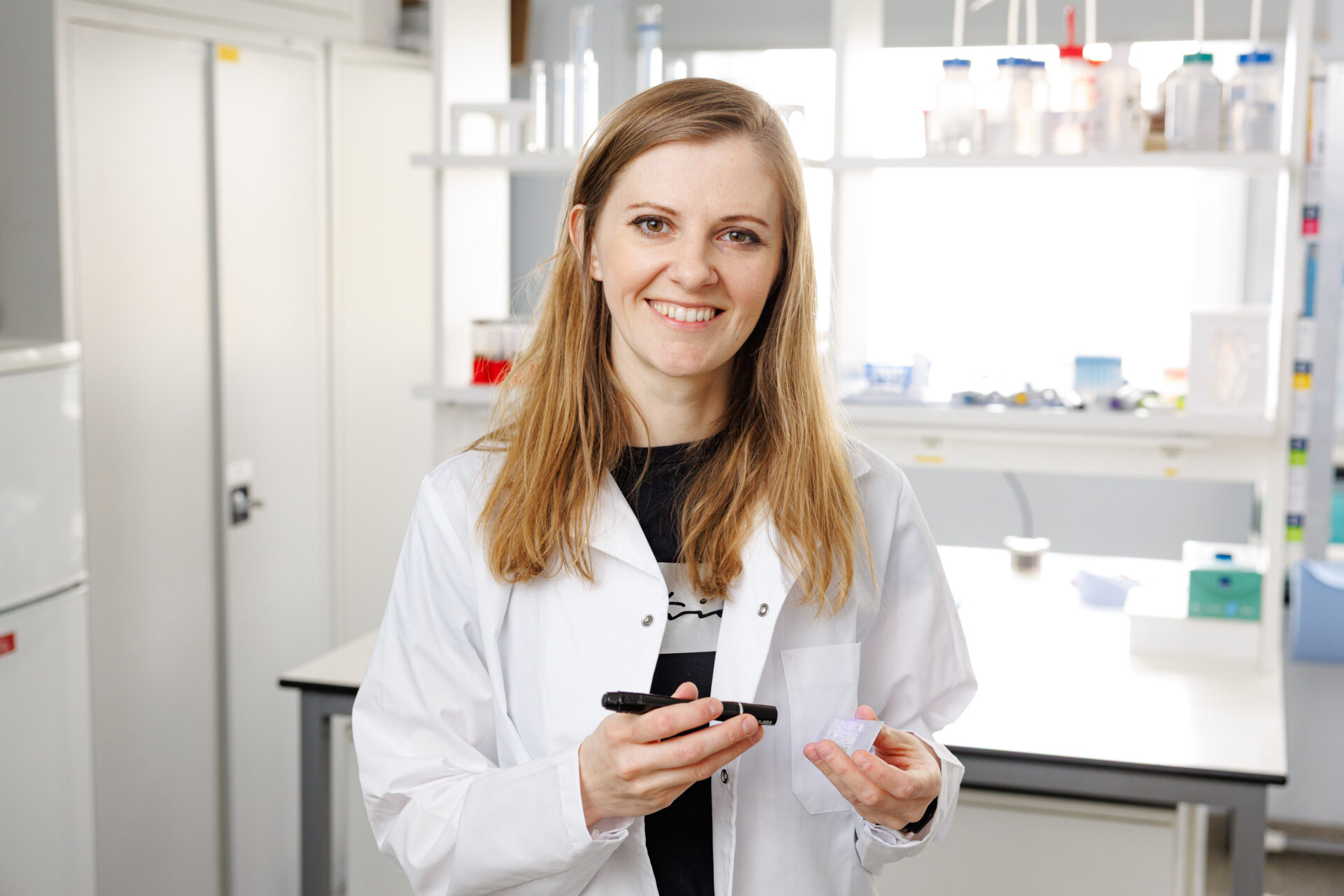
Led by scientist Virgīnija Vītola, researchers from the ISSP UL “BioPhoT” are participating with DARS project, which was a concrete and acute challenge. A night on the road can cause trouble even for experienced drivers – European Union statistics report that 30% of all nighttime road traffic accidents resulting in fatalities occur because a vehicle runs off the roadway. Especially dangerous are blind curves and turns, where standard road signs and guardrails lie outside the direct light cone of the vehicle's headlights.
The method proposed by the researchers involves using a laser to apply a thin layer of long-persistence luminescent material onto an aluminum substrate, thereby treating existing road signs or other road marking elements with a waterproof and durable coating. This solution would allow them to absorb light from the headlights of passing cars and glow on their own for several hours. The visibility factor is improved both generally and from various angles, making road curves more visible. The material developed for the project is energized (or excited) by the blue part of the light spectrum, including sunlight, indoor LED lighting, urban lighting, and, of course, vehicle headlights. Although a passing car is opposite a road barrier for only a moment, the light from modern car headlights is intense enough to charge this material.
Over time, the concept of road safety has evolved, and the project team is now also looking at more flexible and smaller-scale solutions – easily bolt-on elements for road safety barriers, delineator posts, and other urban installations. “There is noticeable interest from urban planners and municipal representatives,” says project manager Virgīnija Vītola. By cooperating, we can practically observe how the coating performs in a real urban environment, how it reacts to outdoor conditions and light, so that we can draw conclusions about its applications.“
The technology is also being demonstrated to potential partners outside the road infrastructure sector – within the framework of “BioPhoT,” the researcher team has seized the opportunity to attract business developers, through whom discussions have already been initiated with several Swiss watch manufacturers. The researchers conducted comparative measurements with luminescent materials embedded in wristwatch hands and dials – by irradiating the materials for one minute and observing the luminescence intensity over the course of an hour, the coating developed by DARS demonstrated a significantly higher initial brightness as well as a slower decrease in intensity compared to materials widely used in watch dials.
Vītola smiles, noting that this is one of the most active periods she has experienced in her career. Such a rapid pace of business and innovation development has been largely determined precisely by participation in the “BioPhoT” program. Unlike traditional scientific projects, the focus of the BioPhoT platform is commercialization. This means strict deadlines, the requirement to build minimum viable product or the minimum viable product, as well as scientists going to talk to investors and industrial partners, rather than just academic research conferences. However, the manager of the DARS project points out how important long-term, patient fundamental research is for deep tech: “The opportunity to create DARS arose for us because we had already spent years studying these luminescent materials in a wide variety of fundamental research projects, so we knew a great deal about them and were able to develop a suitable material in a short period of time.”
Traditionally, commercialization calls and investment funds often require technology to be fully defined and ready for market entry right from the start. “BioPhoT” is unique because it provides the opportunity to develop and adapt early-stage ideas, resulting in many convenient paths to turn scientific discoveries into market-ready products. However, the platform is more than just a source of funding—as Vītola mentions, during the project, researchers have gained a lot from the engaged business developers and mentors who provide their expertise throughout product development and actively work to attract potential collaboration partners. “BioPhoT” also offers workshops and masterclasses aimed at developing researchers' skills to present their research to a broad audience outside of science or to speak privately with potential investors.
Currently, the DARS team is actively working on further scaling the innovation. The level achieved so far makes it possible to practically demonstrate the innovation's capability to work with demonstrators and to fulfill small-scale orders, but the project team continues to grow and adapt its innovation. Scientists are also continuing research on how to apply the synthesized persistent luminescence material to various types of metals while avoiding microscopic defects that could diminish the glow, as well as how to form free-standing ceramic structures from the material—in this way, a base for applying the material would not be needed, instead allowing the development of a persistent luminescence component whose shape and application could be customized as needed.
The DARS project truly highlights that Latvia's photonics and materials science sector has something to offer to the international innovation market. By combining the accumulated fundamental knowledge base of Latvian research institutions with the commercialization capacity provided by “BioPhoT,” products are emerging that not only can improve road and urban safety, but also demonstrate that world-class and commercially forward-looking ideas are flourishing in Latvia.