Please note that the English version of this text has been prepared with the assistance of AI, and in some instances, it may not have been subsequently reviewed or edited by the authors.
Latvia has the scientific competence, manufacturing capacity, and necessary experience to promote the production of critical medicines in Europe and reduce dependence on supplies of active pharmaceutical substances from third countries. To utilize this potential, cooperation is important. This view was expressed during the discussion “Strategic Pharmacy in Latvia: Science, Production, and Competitiveness” by representatives of the National Research and Innovation Institute (NRII): Dace Kārkle, Acting Director of NRII, and Osvalds Pugovičs, Head of the Biomedicine and Photonics Innovation Platform “BioPhoT” and Acting Director of the NRII Teika Science Center.
“The conference ”First Line of Defense: Healthcare and Pharmacy in National Resilience,“ organized by ”Dienas Bizness," took place in Rēzekne at the Embassy of Latgale GORS, where issues regarding the availability of critical medicines in crisis situations were also discussed.
Science can help improve the availability of critical medicines
Dace Kārkle emphasized that, in preparation for crisis situations, research institutes can develop technologies for the production of patent-free medicines and transfer them to local manufacturers. This issue is particularly relevant at a time when Europe is seeking solutions to strengthen supply chain resilience and reorient the production of active pharmaceutical ingredients from China to Europe.
She pointed out that the Latvian Institute of Organic Synthesis (LIOS), which is the predecessor of NIRI, has developed more than 100 generic drug manufacturing technologies over the course of its operations. This experience is a significant foundation for future cooperation with pharmaceutical manufacturers, particularly regarding medicines included in the critical medicines list. A large proportion of the medicines included in this list are generics.
To transfer scientific technologies to pharmaceutical manufacturers as quickly as possible, close cooperation is needed between researchers and companies capable of implementing the developed technologies in practice. “Latvia has the complete set necessary to reorient production to the European Union (EU) and contribute to strengthening the resilience of EU and Latvian supply chains and the security of critical medicines. We have science capable of developing methods, and manufacturers who have the capacity, experience, and ability to implement them. We are small and agile enough to be flexible, but we must want to cooperate,” emphasized Dace Kārkle.
She invited to use the opportunities offered by the European Union, including the strategic projects of the Critical Medicines Act and the funding instruments of the next planning period, to develop production capacity and attract the necessary investments.
“Quote“The ”BioPhoT" platform is an opportunity to combine scientific competencies
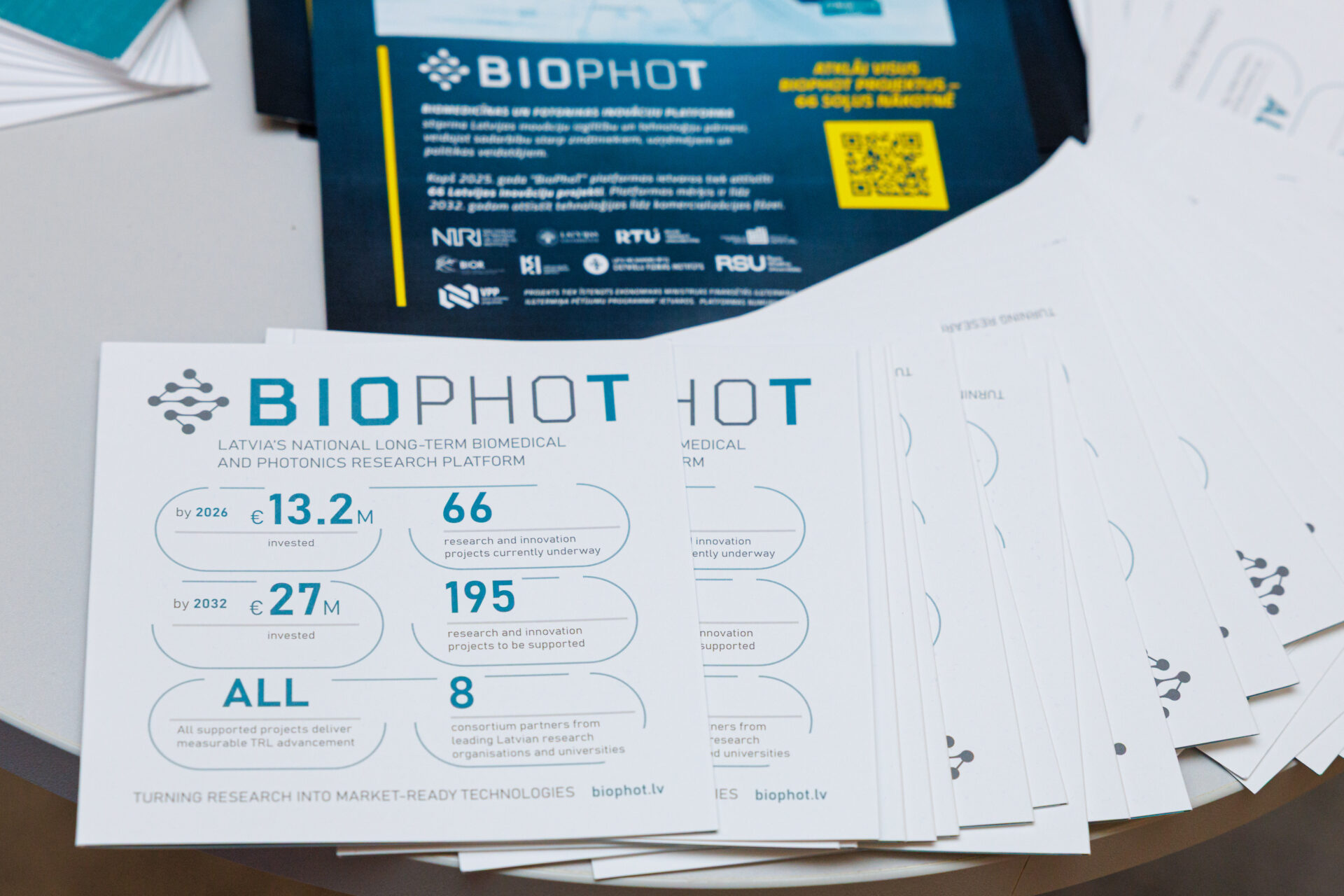
Speaking about the role of science in the development of the pharmaceutical industry, Osvalds Pugovičs emphasized the importance of interdisciplinary cooperation. In Europe, research platforms where multiple scientific institutions combine their knowledge and competencies to solve common tasks are becoming increasingly relevant. In Latvia, this approach is represented by the “BioPhoT” platform, which has been operating for almost two years.
The platform offers a wide range of research competencies and an interdisciplinary approach, but its development requires a more active and open discussion with the pharmaceutical industry. Currently, the platform is developing primarily as a researcher initiative, so closer cooperation with companies would help better identify industry needs and direct research toward results in demand by the sector. He also pointed out the potential role of the state in promoting this cooperation—targeted support instruments could encourage science-industry collaboration and accelerate the introduction of new solutions.
How to substitute critical raw materials?
Osvalds Pugovičs pointed out that science can contribute not only to the development of existing production technologies, but also to the creation of new solutions that would help reduce dependence on critical raw materials whose supplies may be disrupted. “Science has the opportunity to demonstrate the potential of innovation by developing unprecedented drug manufacturing technologies. Our institute has proven this repeatedly. This takes time, so we cannot delay too much,” he stated.
What was expressed in the discussion confirms that Latvia's opportunities to strengthen pharmaceutical manufacturing are closely linked to the ability to combine scientific competence, corporate production capacity, and targeted state support. Timely action and closer cooperation can help both develop new manufacturing solutions and strengthen Latvia's and Europe's ability to provide patients with critically needed medicines.