Please note that the English version of this text has been prepared with the assistance of AI, and in some instances, it may not have been subsequently reviewed or edited by the authors.
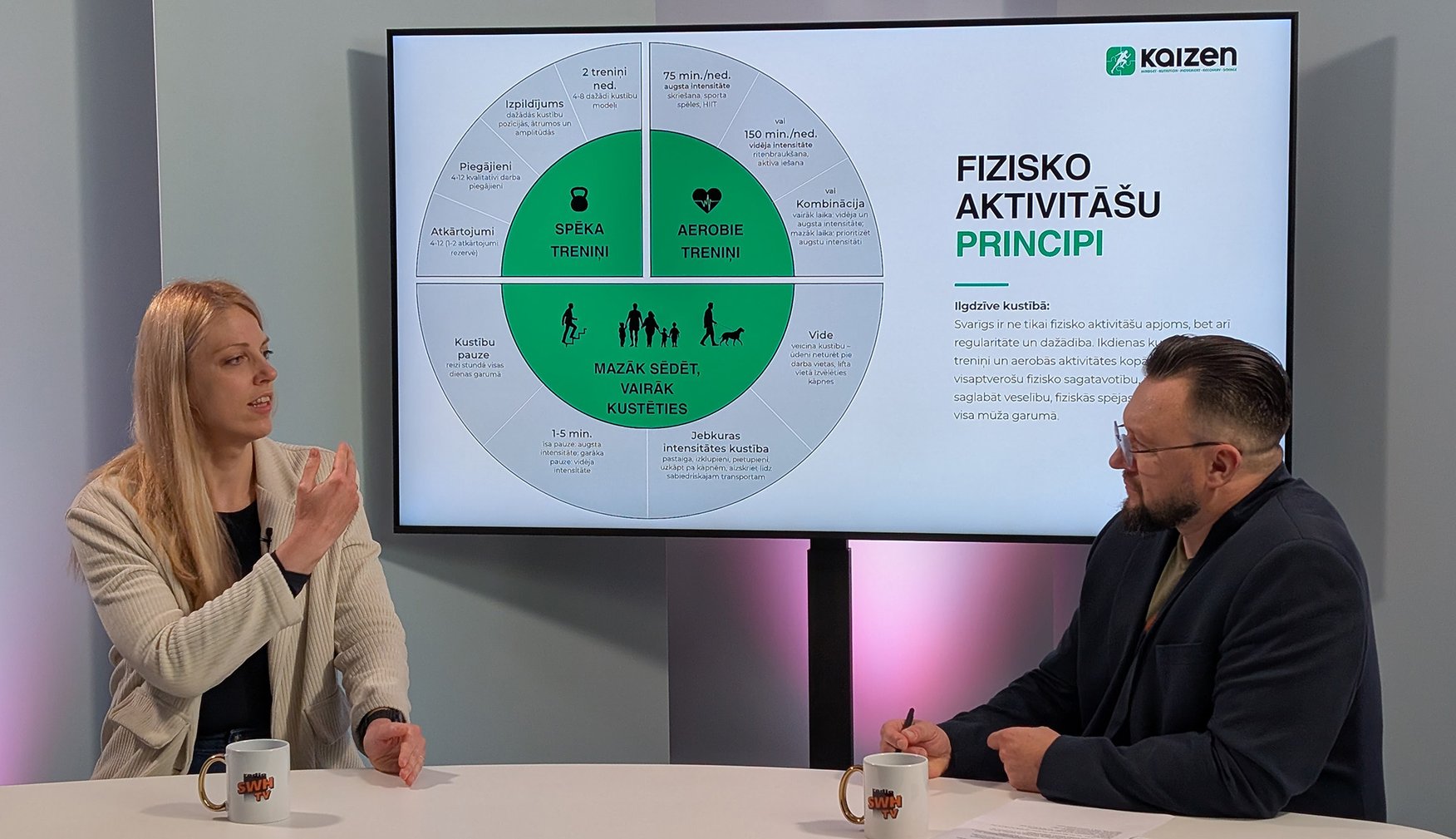
After a hard strength workout, the muscles make their presence felt, but the heart rate monitor may report that the load was light and the body is already ready for the next workout. On the “Radio SWH TV” show “Latvija zinātnē” (Science in Latvia), produced in cooperation with “Rietumu Banka”, Zane Ruža, a researcher at the University of Latvia (UL) and sports science representative, talks about the possibilities of more accurately assessing muscle load and fatigue, as well as a study in which the physical fitness and training load of young athletes are evaluated using various measurements.
“In strength training, heart rate data alone is not enough; it may not be the best indicator to tell how heavy the workload has been. Even though the muscles will definitely be felt the next day, the heart rate monitor will say that no hard workout took place and that one can continue much more intensively. But in reality, that is not the case, Ruža explains.
The researcher, together with her colleagues, began studying the limitations of wearable sports technology thanks to funding from the UL Foundation within the framework of the “MikroTik Project Competition in the Fields of Natural Sciences, Technology, and Medical Sciences.” Currently research on neuromuscular load monitoring has already reached a stage where it successfully launches in the biomedical and photonics innovation platform “BioPhoT”. Work is underway to develop the idea into a real product – the integration of the algorithm into existing sports watches so that, alongside standard training data, they can also provide information on muscle load and fatigue.
“We want to build an algorithm that, based on various movement acceleration data, could also tell how the muscles are working,” says Zane Ruža, a researcher at the University of Latvia (UL) and sports science representative.
To understand how fatigue alters human movement, study participants perform exercises until, due to fatigue, the exercises can no longer be properly continued. “A person comes in, and we ask them to perform exercises until they reach failure. In this way, we want to understand what their movement pattern looks like at various stages of fatigue,” Ruža says. The collected data are then passed on to colleagues who are working on the algorithm.
“Movement data alone might not be enough. Now, in this same neuromuscular project, we are also starting to look at biochemical samples, because I realize that in certain situations, a single movement pattern and acceleration data might not be enough, Ruža explains.
The idea for their own solution came to the researchers while testing various sensors and concluding that the market lacks a suitable way to assess, in the long term, specifically the load and fatigue caused by strength training.
“You couldn't find any good way on the market to quantify the intensity of strength training and identify the fatigue caused specifically by strength training so that we could track it in the long term,” says the researcher: “Then the idea came up – maybe we should start creating our own product, our own algorithm.”
In parallel, Ružs is also researching the physical fitness and training load of young athletes. Currently, the researchers' focus is on young basketball players, whose training process is being evaluated as comprehensively as possible with the help of various measurements.
“We put accelerometers built into heart rate monitor straps. By receiving data on movement and heart rate intensity, together with physical conditioning and basketball coaches, we use them to look for opportunities to better adapt the training process and reduce the risk of overexertion, says Ruža.
The measurements do not end there. Force platforms, on which athletes perform jumps, are also used, along with the assessment of maximum strength. The researcher emphasizes that if the training approach is to be truly individualized, especially for athletes with the goal of improving performance, various measurements must be used and the obtained information must be viewed comprehensively.
“In the ”BioPhoT“ platform, a researcher must think not only about how to make their solution increasingly precise. Ruža also works with a mentor and business developer, which gives rise to another question, one not always familiar to a scientist. ”We think about how something could be made more precise so that the product becomes of higher quality, but the next question is – will the industry need it?” says Ruža.
This perspective has been helped to develop by the support of the University of Latvia Innovation and Acceleration Centre and participation in the “Latvia-Cambridge Venture Camp” – researchers must think not only about the scientific side of the idea, but also about whether the solution is needed and whether it would have potential in a broader market.
For now, researchers are still on their way to this goal. However, the intention is clear: to ensure that in the future, technology can tell us more about a workout than just how fast the heart was beating during it.
The Radio SWH TV broadcast “Latvia in Science” introduces Latvian scientists, researchers, and innovators whose ideas and achievements are shaping future technologies and solutions, while simultaneously revealing science as a fascinating and human process. Conversations with scientists are produced in cooperation with “Rietumu Bank” – excellence is never a coincidence. Scientists are supported by the University of Latvia Foundation.
The show can be watched on Radio SWH TV on Thursdays at 20:00, while the repeat is on Sundays at 15:00.