Please note that the English version of this text has been prepared with the assistance of AI, and in some instances, it may not have been subsequently reviewed or edited by the authors.
Article originally published on the portal ir.lv
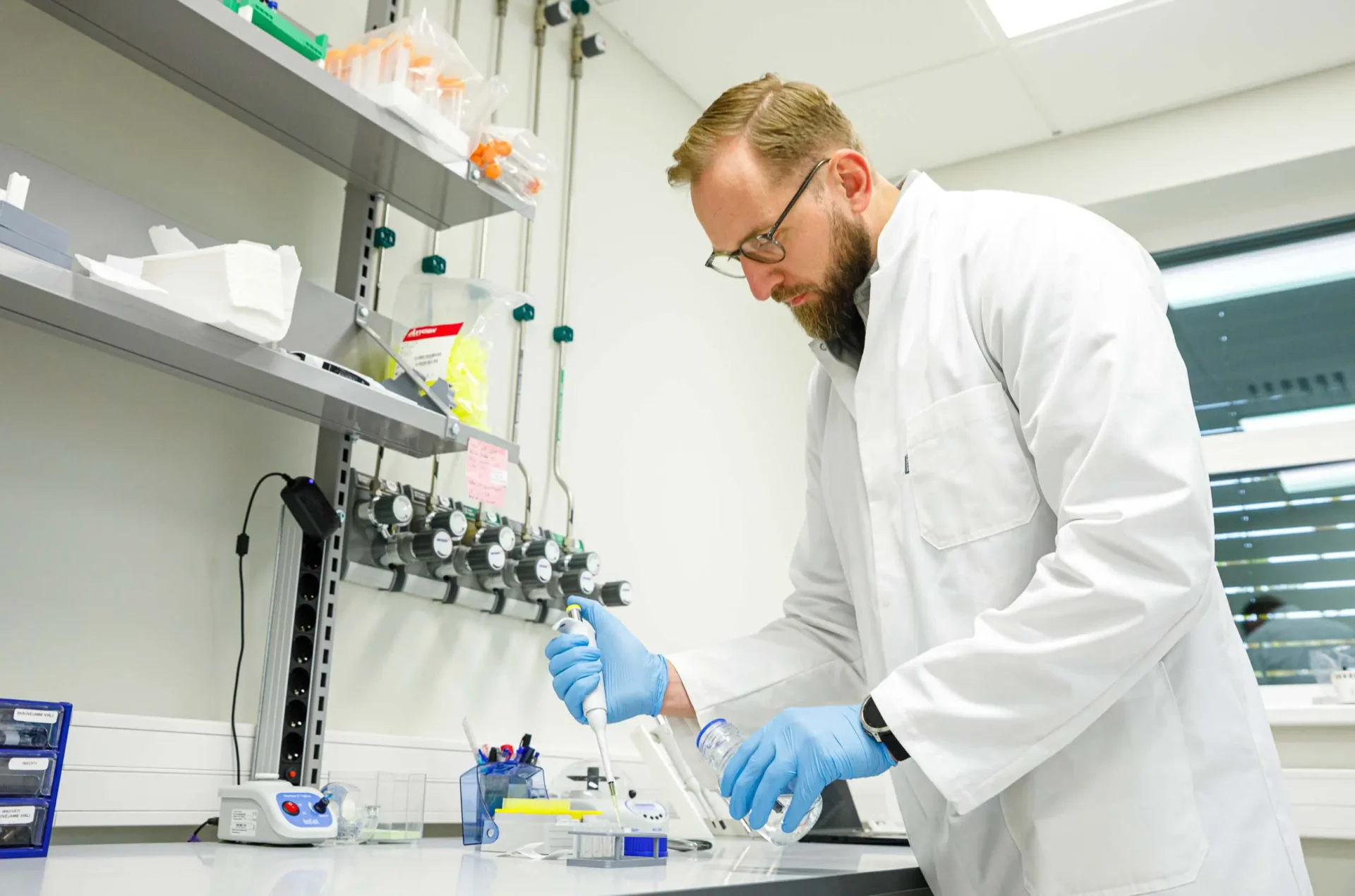
On a hot summer day or after physical exertion from hard labor, everyone has experienced a thin layer of sweat breaking out on their forehead. This is also well known to medical professionals in the Neonatology Department of the Children's Clinical University Hospital (BKUS). Here, daily life is spent caring for the smallest and most fragile patients – prematurely born babies. One of the routine procedures is taking blood tests, which are performed on average up to 7 times a day. Up to 5% of the total blood volume can be taken for these tests. This is a physically demanding and exhausting process for the patient, creating additional risks for babies who are already in a risk group.
Precisely this harsh reality has become the driving force for a promising For the project of Latvian researchers SwyCard. However, the journey from a promising laboratory discovery to a finished product available in doctors' offices and clinical laboratories is challenging. This phase, often referred to as valley of death, helps to overcome the long-term state research program project BioPhoT – Biomedicine and Photonics Innovation Platform, which provides the crucial funding, knowledge, and support so that ideas generated in Latvia do not remain merely on the pages of scientific publications, but transform into commercially successful, globally scalable products.
But what actually is SwyCardThe innovation created by researchers at the Institute of Biomaterials and Biomechanics of Riga Technical University (RTU) offers to replace blood tests with a non-invasive and painless method: analyzing sweat. As explained SwyCard project manager and scientist Kristaps Kļaviņš says the project's story began with a very practical request from the outside. “In 2023, Dace Gardovska, a professor at Riga Stradiņš University (RSU), and doctors from BKUS approached us. They were very interested in finding non-invasive ways to perform analyses on premature babies. That is how we started researching what else could be collected from a baby for analysis – initially we considered urine, but it can be inconvenient to collect and the amount is insufficient. As the next option, we turned to sweat metabolism,” Kļaviņš recalls.
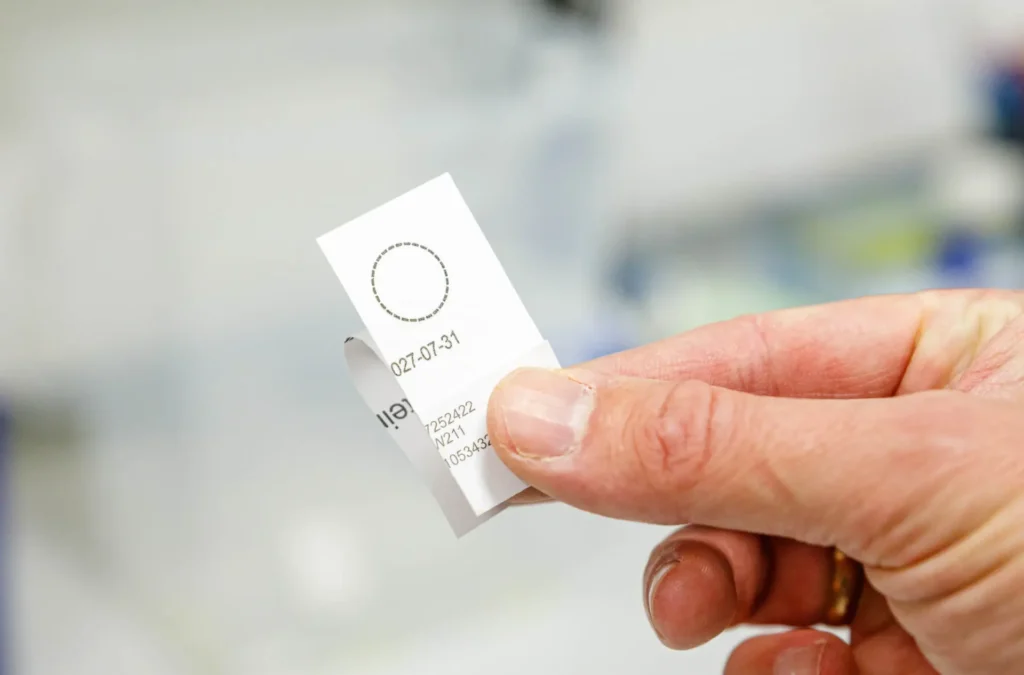
Research has revealed an encouraging fact – at the molecular level, sweat contains a fairly large amount of information. It can detect glucose, creatinine, uric acid, and other clinical markers that are already widely used in medicine. Using mass spectrometry – a high-sensitivity analytical method available in medical institutions such as the Children's University Hospital (BKUS) or E. Gulbis Laboratory —, researchers realized they had arrived at a very real solution to the hospital doctors“ request. The doctor or the patient simply needs to clean the skin, drop a saline solution onto a special paper card, press it to the skin for a couple of seconds, fold it, and send it to the laboratory. There, a small paper disk is punched out of the card, from which the sweat sample is further extracted for measurements. ”Cards of this type are already used for blood tests in screening newborns for genetically inherited diseases,“ Kļaviņš emphasizes, pointing out a significant advantage. ”They are familiar to doctors and laboratories. They don't have to buy new, unfamiliar equipment or tests—we are simply offering a new sample type that fits into the existing workflow."
Engagement with real-life situations and the user has been central to the development of the project – this is vividly illustrated by the story of the card design. “We went to the Children's Hospital and watched how analyses are performed,” says the project manager. Traditionally, blood samples are dropped onto white paper, where the red tone is a clear reference point for the laboratory technician who punches out pieces from the card for further analysis. However, sweat is transparent and leaves no trace on white paper after drying. This realization led to SwyCard pink cards; when coming into contact with sweat and liquid, the paper fades slightly and creates the necessary visual marker. “You wouldn't imagine it without doctors around in action,” Kļaviņš laughs.
When grants from the Latvian Council of Science and other research funding sources had laid the scientific foundation and the discovery was made, the next, much more complex question arose – how to turn this science into a product? Most traditional research grants cover aspects such as reagents and materials or researcher salaries, but funding is not intended for commercialization, prototype testing, and market research. This is precisely where BioPhoT The crucial role of platforms.
“We had a defined problem. Doctors can’t get blood – what else can we use? Look, we found a solution with sweat. But what’s next?” says Kļaviņš. “As it happened, right around that time appeared BioPhot. We want to commercialize the idea, and, behold, they provide support specifically for commercialization.” Furthermore BioPhoT does not mean just funding - it is a structured mentoring and educational process. For example, the program teaches how to pitch an idea to investors, warning that in 90% of cases the answer will be no. “Scientists are not afraid of rejections anyway,” Kļaviņš laughs, pointing out that the success rate for obtaining scientific grants is only around 10%, so such disappointments are not unfamiliar to researchers. Navigating the business world is more complicated - product registration, clinical trials and regulations for medical devices, intellectual property strategies, etc. To help with this, BioPhoT within the framework of the project, a mentor has been assigned to the team, who both provides consultations and helps practically. Likewise BioPhoT funding has allowed the involvement of cooperation partners at Children's Clinical University Hospital and E. Gulbis Laboratory, which would be nearly impossible within the framework of a scientific project.
“Along with BioPhoT that “hobby” project, to which you previously devoted time in the evenings and on weekends alongside your main job, can become paid work,” the scientist describes the relief provided by the program. It has provided the opportunity to build a team with a broad research group, which allowed for a significant acceleration of technology and product development. As well as giving the opportunity to focus on business development, preparing SwyCard in conversations with investors and venture capital funds, providing reasoned answers regarding market location and size, customer base, and commercialization models.
Looking to the future, SwyCard the potential extends far beyond the wards for premature babies. A clear trend is emerging in the industry toward alternatives to mass blood tests. As Kļaviņš heard at a conference, around 10 Olympic swimming pools of blood are drawn worldwide for blood tests each year, while only four are donated to the Red Cross. Medicine is moving toward microsampling, such as taking a drop of blood from a finger for diabetes patients, as well as home testing. Although sweat yields relatively noisy samples with low biomarker concentrations, modern mass spectrometry technologies have already opened the door to them as a realistic alternative for analysis: it can be used by people with kidney disease who need to be tested daily; oncology patients with damaged veins; and patients living in remote regions or with mobility impairments.
SwyCard the story is a testament to what can be offered BioPhoT and the Latvian innovation ecosystem. Right here, science-intensive ideas with global commercial potential are being created. But ultimately, the scientists“ motivation is not millions in profit, but a real impact on society. ”I went along with doctors and watched how blood is drawn from those children. I have a four-year-old at home myself, who is not exactly thrilled about needles. You see that there is a genuine pain and a problem that you can solve,“ says Kristaps Kļaviņš. "In science, our product is knowledge. A great Aha There was a moment when I realized that for all of this to have any impact, the final result has to be a product. So that people and doctors can buy it or, when going for lab tests, check it as an option and receive the service. Only then does it truly make sense.”
Thanks to the passion of Latvian scientists and the platform BioPhoT, this notion has already begun to take tangible shape in the form of a pink card with the potential to change diagnostic standards worldwide.
Project “Biomedicine and Photonics Research Platform for Creating Innovative Products” or “BioPhoT” is implemented within the framework of the long-term state research program “Innovation Fund – Long-Term Research Program” funded by the Ministry of Economics. Platform number: IVPP-EM-Inovācija-2024/1-0002.