Please note that the English version of this text has been prepared with the assistance of AI, and in some instances, it may not have been subsequently reviewed or edited by the authors.
On November 24, Riga Stradiņš University (RSU) hosted the second event of the “BioPhoT” cycle, “Industry Day & Sensing the Future,” bringing together researchers, entrepreneurs, representatives of patient organizations, state institutions, and the healthcare sector. At the center of the event was the recognition that a good scientific idea is not enough for successful healthcare innovation: for a solution to reach the patient, close cooperation among patients, researchers, doctors, industry, and regulators is necessary already at an early stage of development. Participants discussed patient involvement in the development of new solutions, barriers to innovation implementation, and opportunities to create new models of cooperation.
“The focus of the ”BioPhoT” Industry Day was collaboration that helps turn research results into products and technologies useful for patients and healthcare professionals. The day's program combined expert experience stories, a panel discussion, researcher and industry working groups, as well as an opportunity to get acquainted with RSU research infrastructure.
The event was opened by Agrita Kiopa, Vice-Rector for Science of RSU, focusing on the question of why cooperation in innovation development is important for both public health and the national economy. The collaboration of researchers, medical professionals, and entrepreneurs helps to timely identify healthcare needs and pave the way from a scientific idea to a solution that can be applied in practice.
Lithuanian experience in promoting the introduction of innovations was presented Giedrė Kvedaravičienė, Director of the Biobank of Lithuanian Population and Rare Diseases at Vilnius University. Meanwhile Osvalds Pugovičs, head of the Teika Science Center at the National Research and Innovation Institute and head of the “BioPhoT” platform introduced the opportunities offered by the platform to the industry and its involvement in the development of research results.
The role of patients in creating innovations was explained Tamás Bereczky, representative of the European Patients' Academy on Therapeutic Innovation (EUPATI). Her presentation was dedicated to the early identification of patient needs, patient involvement in product development and clinical trials, as well as the knowledge and skills necessary for full participation. Professor Kristīne Šalma-Ancāne, Director of the Institute of Biomaterials and Bioengineering at Riga Technical University introduced the experience of the Baltic Biomaterials Excellence Centre, demonstrating the importance of institutional cooperation in the development of new biomaterials and medical technologies.
Meanwhile, the panel discussion “Three Truths, One Goal – From Prototype to Patient” focused on the perspectives of patients, researchers, entrepreneurs, and regulators regarding the development of new solutions, the importance of early patient involvement, and the stages where collaboration may be delayed. At its core was the question of how to align the needs and requirements of various parties during the development process in order to facilitate the solution reaching the patient.
As part of the Industry Days, the practical workshop “Reality Check” also took place, where research groups met with industry representatives, state agencies, startups, and policymakers. Discussions took place in thematic rooms focusing on diagnostics and biomarkers, drug development and advanced therapies, biomaterials and medical technologies, as well as digital health and artificial intelligence. The “Reality Check” format allowed projects to present their solutions and identify the next steps for development, as well as to meet representatives of various institutions and companies in one place, discuss project needs, and explore previously unused cooperation opportunities.
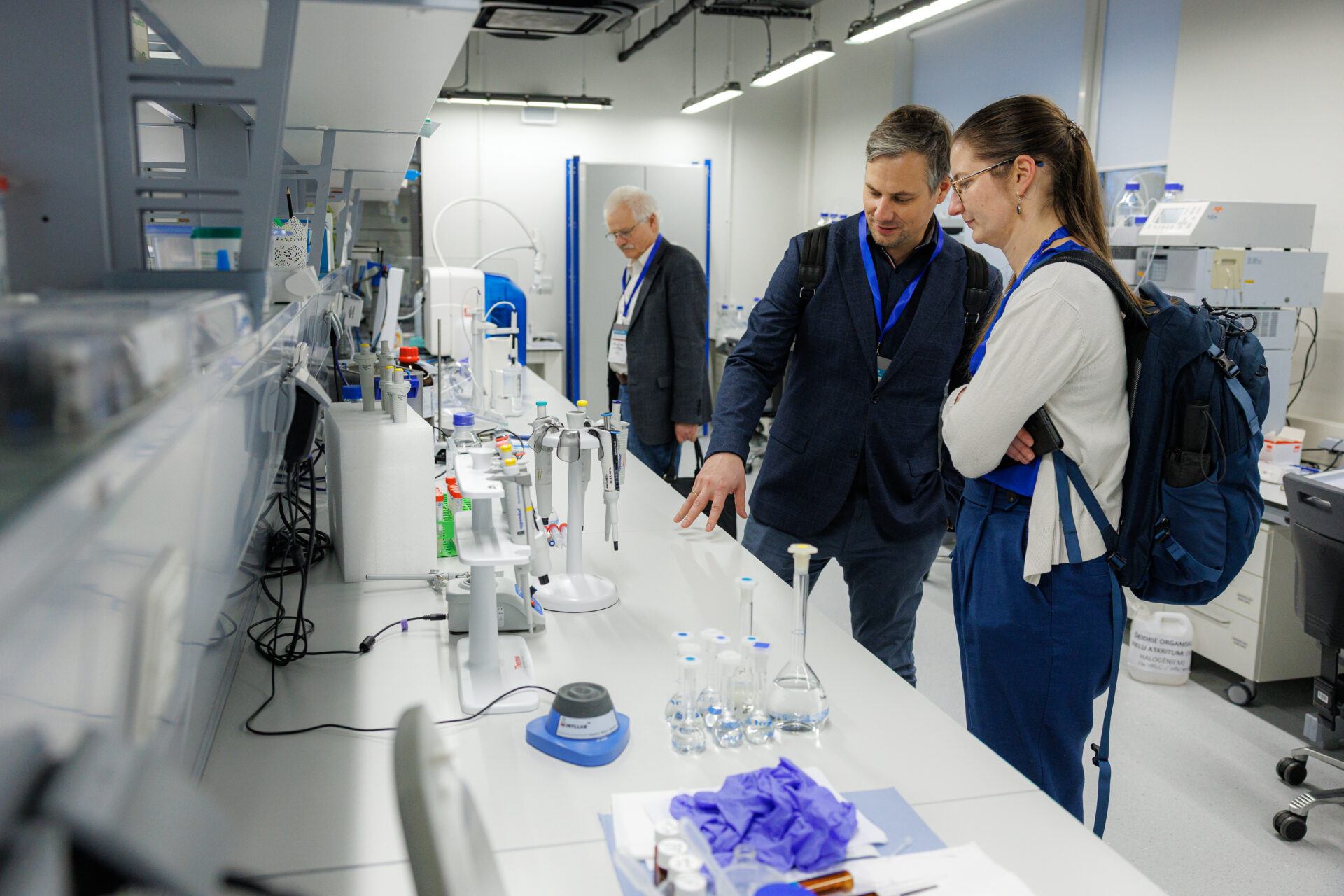
During the day, the RSU Faculty of Pharmacy Laboratory of Finished Dosage Forms introduced visitors to pharmaceutical technology and drug formulation development capabilities, analytical and technological equipment, as well as the laboratory's offerings for cooperation with the industry. The laboratory's research directions include improving drug bioavailability, the use of polymers in pharmacy and biomedicine, as well as the development of natural-origin products and wound-healing agents.