Please note that the English version of this text has been prepared with the assistance of AI, and in some instances, it may not have been subsequently reviewed or edited by the authors.
The interview has been published on the website of the Latvian Council of Science
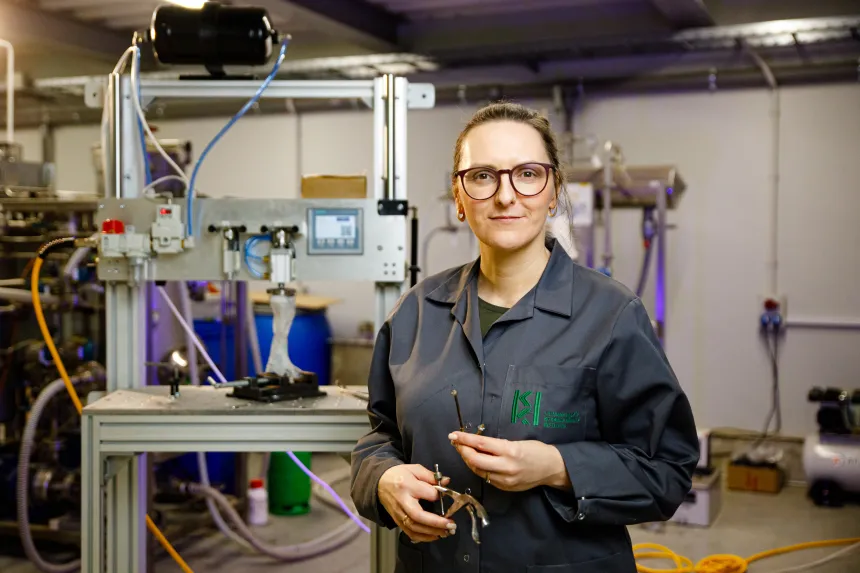
Leading researcher of the Latvian State Institute of Wood Chemistry (LVKĶI) and “BioPhoT” OsteoWood project“ Dr. chem. Laura Andže was the only representative from Latvia who participated in the European Research Council (European Research Council - ERC) 2026 Starting Grant She was invited to the interview round of the competition.
In the project that Laura submitted to the ERC competition, it is planned to use several naturally derived polymers to give wood the stability and mechanical properties required for medical implants. At the same time, it is planned to find out how these polymers penetrate the wood structure and chemically bond with each other and with the wood matrix – these interactions have not been studied so far, Laura says. The project would also include an in-depth study of the bone cell response and, ultimately, testing of the most suitable materials in an experimental rat model.
During the conversation, Laura shares more about her experience preparing an application for the ERC grant competition and the path to the interview, as well as sharing insights gained during the process.
“We are trained to justify projects with questions: where the results will be used, what it will give to society, how it will be produced, and who will use it? The ERC first asks something else: how does it work, what is actually happening there, and why does it happen specifically that way?” Laura says.
Tell us about your project submitted for the ERC grant. How did the idea for your project originate, and what preliminary work for it already existed in your previous research?
This idea began to take shape about five years ago, when two surgeons from the Microsurgery Center came to our institute with what was then a rather bold proposal: to manufacture osteosynthesis implants from wood, meaning implants for fixing broken bones. They introduced us to Song and co-authors in a 2018 journal Nature published research showing that the strength of chemically treated and densified wood can be significantly increased.
At that time, I had recently returned to science after a long absence, so I embraced this unusual idea with great enthusiasm. For the first three years, we funded the initial experiments with the institute's internal grants. In parallel, I submitted applications for Fundamental and Applied Research Projects (FLPP) three times, but unsuccessfully. Later, we received partial support in the state research program “Forest4LV”, but currently we are continuing our work in the state research program “BioPhoT” project “OsteoWood”. So we are moving in small but steady steps, gaining new knowledge about the material's possibilities and limitations with each project.
After the unsuccessful LZFp applications, my colleagues, especially Dr. chem. Kristīne Meile, encouraged me to apply for the ERC competition: if a topic seems too ambitious for the LZFp, it might be just right for the ERC. However, an ERC application is not simply a larger version of the current “OsteoWood” project. It is much more complex and richer in fundamental science.
How long did you work on the application and what available support did you use?
The intensive writing of the application lasted for about six months. It was a regular weekly effort—we wrote, discussed, criticized, and rewrote the text. However, the project idea itself and its scientific logic had begun to take shape at least a year earlier. You can write an application in six months, but you cannot create a mature scientific idea from scratch.
First, I participated in the training organized by the National Contact Point, where I gained an understanding of the specifics of the ERC call and practical writing principles. Afterwards, I took the opportunity to discuss my idea and draft application in an individual consultation. During it, the project's strengths and weaknesses were explained very clearly, as well as the issues that required special attention. This helped to look at the proposal for the first time not only from a researcher's perspective, but also from the viewpoint of an ERC evaluator.
In the final stage, I worked very closely with the consultants engaged by the Investment and Development Agency of Latvia. It was an intensive but excellently managed process with regular discussions, specific tasks, and many versions of the application. I learned to express complex science as concisely and focused as possible, clearly demonstrating the main issue, the potential breakthrough, and my role in achieving it.
I completely rebuilt my CV as well. As the consultants aptly put it, at first I had a “great CV for a job interview,” but not an ERC CV. An ERC CV must not only list what has been accomplished—it must show scientific independence, original thinking, personal contribution, and the ability to establish one's own research direction.
Tell me more about interview preparation and the interview process itself.
Even preparing for the interview was a very interesting and intensive process. First, I created a list of potential questions myself—I tried to imagine everything the panel might ask about the grand idea of the project as well as the methods, risks, and my experience. After that, I asked colleagues to form a mock panel and prepare their own questions. Meanwhile, the consultants had compiled both general and very detailed questions, so the next task was to think through and prepare precise answers.
We met with the consultants four times in Zoom sessions. First, I presented the prepared five-minute presentation, which we jointly analyzed and polished—sometimes down to the individual word. After that, I trained the Q&A part: how to answer briefly, clearly, and concisely, without verbosity and without drifting off into side topics. That is not so simple for a scientist, because one always wants to tell more about their research.
Such training is very valuable regardless of the contest outcome. It teaches how to quickly grasp the essence of a question, clarify a thought, and express a complex answer in a few understandable sentences. This skill will be useful to me not only in the next ERC application, but also at conferences, in project defenses, and in conversations with cooperation partners.
Work on an ERC grant is usually considered a very individual process, but did you also receive support from colleagues when preparing the application and preparing for the interview?
The ERC grant is indeed very individual—the project idea and scientific vision must belong to the researcher themselves. However, individual does not mean lonely. I received support from colleagues both in developing the initial idea and later, while preparing for the interview, when we jointly formulated potential questions and organized a practice panel.
Extraordinary support was provided by my LSIWC colleagues – Kristīne Meile, Jānis Rižikovs and Inese Fiļipova, as well as Mārtiņš Andžs, who is not only a colleague but also my husband. They helped critically evaluate both the project idea and my arguments and responses.
Also very significant was the contribution of collaboration partner Anton Sizov from the Latvian Institute of Organic Synthesis, now the National Research and Innovation Institute (NIRI). He looked at the project from a biological and medical perspective, particularly helping to rethink in vitro and in vivo research. In an interdisciplinary project, such a diverse perspective is essential because it allows for timely identification of issues that a researcher in one's own field might miss.
Looking back at the experience gained, what would you do differently now?
The support received in preparing the application and interview training was very good. However, now, after the entire process and the experts' evaluation, I see much more clearly what the project itself lacked.
First of all, additional preliminary tests on critical project issues are needed. I myself need to gain much greater confidence that the intended mechanism will work, so that I can then also convince the evaluators of this. Experimental uncertainty cannot be replaced by a good text alone.
Secondly, the project needs a much deeper layer of fundamental science – more science for the sake of knowledge itself. And this, in my opinion, reveals a broader problem among Latvian researchers. We are trained to justify projects with questions: where will the result be used, what will it give to society, how will it be produced, and who will use it? The ERC first asks something else: how does it work, what is really happening there, and why does it happen precisely this way?
Those are two very different systems of thought. While preparing the next application, I would also look for a foreign scientific mentor – not another text editor, but an experienced researcher who routinely thinks in such fundamental categories and is capable of ruthlessly and critically testing the scientific core of the project.
What recommendations or motivational words would you say to colleagues and fellow researchers who are still considering applying for one of the ERC grant competitions?
Just do it! There are many more scientists in Latvia with brilliant ideas and the ability to prepare competitive ERC applications than we sometimes dare to believe ourselves. There is no need to wait for the moment when the idea, CV, and all circumstances seem perfect – that moment will likely never come.
We need to start, learn, and try. Even if funding is not secured on the first attempt, the process itself helps to see one's scientific idea much more clearly, its strengths, and what still needs to be done. On the other hand, by not submitting an application, the outcome is known in advance. Therefore, my motivational phrase would be what the current President of Latvia once said: “What if it works out?”